Showing posts with label learning. Show all posts

Nomenclature

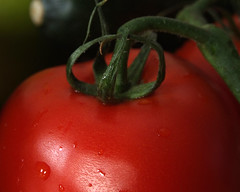
The humble tomato: Fruit or Vegetable?Image by Ollie T. via Flickr

A system or set of terms or symbols especially in a particular science, discipline, or art. 1

The classification of items sometimes varies by the system being used to classify. I wrote a post that include a teacher who marked a child wrong for saying a tomato was a fruit. The problem in that story is that there are two system to classify a tomato.

The first system is that of science and the parts of a plant. In that system, a tomato is a fruit,. a carrot is a root, and broccoli is a flower. Each is a part of a plant.

I suspect the teacher wasn't thinking about that system when she marked the student wrong. Instead she was thinking of another system: food groups. She might have even taught a lesson on food groups. In that system the tomato wasn't a fruit instead it was a vegetable. While that system is less precise in its divisions, it was nevertheless a valid system. Most of us can divide the things I listed above as well as others by the same set of rules. Fruits are sweeter and have more simple sugars. Vegetables don't have a lot of sugars. Starches are plant parts that include more complex sugars. Finally, oils are extracts of plants that contain pure fat (and are the only category that can also include animal products). Unlike the plant part system this one has no clear dividing lines and some items are sorted differently depending on who's doing the sorting.

Children mostly grow up figuring out hundreds of these informal classification systems. Is a color green or blue? Is that a bird or an insect? What's the weather like? In many ways they are much more advanced scientists than us adults who don't have to sort all of life into categories because we have already excepted those divisions of life.
Reblog this post [with Zemanta]

How to Read 2

This is the third of a series of posts about this article.

Lastly Bauer includes some tips on how to go about thinking about and setting up a reading program. Most of them I agree with.

In large part, the project of classical education is an act of resistance against mainstream culture. It sends a message: “I don't care how fast I do this. I don't care how much of it I do. I don't care how many books I get through. I am not in search of immediate gratification and visible results." This pushes back against our society, which tells us that the faster we work, the more we do, the more we produce and accumulate and experience, the better we are.

I agree. I would add that sometimes it helps to take a break midway in a book. I find this to be especially true of long works of nonfiction. I even decide with some books when I will take a break. In one long history of a very minor technology that I am interested in, I took a break every 200 pages. The material was dense and I need to spend a few days reading a light weight novel. In my most recent book on the Civil War, I planned and took a break at the middle of the book.

One point I did not completely agree with is her suggestion to read in the morning. I've heard that advice a lot over my life, but it just doesn't work out for me. For me the morning before breakfast is a time to get things done. I read, gasp, at the end of the day when my children go to bed, but I admit I also manage to sneak in reading through out the day. I encourage you to find your own time and sneak some reading into those empty moments that happen all through most people's day.

Bauer also suggests reading genre's chronologically. I don't see the necessity in this. Certainly there is an evolution in literature's forms, but if you always wanted to read War and Peace, don't fell you must read 25 other novels before you begin it.

Blue ImpactImage by thefost via Flickr

One point I would suggest is to take some time deciding what level of reading you are at. If you've been reading light weight popular novels and books of encouragement then you may wish to not immediately leap into deep and dense works, but instead begin with some shorter less dense works of literature or more popularized books of nonfiction. Going from Stephen King to Plato might be an unwise choice. There are many easier works to begin with; Greek drama, in my opinion, is easy to read and enjoy.

And if one works stumps you, put it aside after a set number of pages (10 -25 percent is a good goal) and try something else. Whatever you do, don't pick something because it is a classic instead pick something you are interested in.
Reblog this post [with Zemanta]

How to Read 1


Although overall I love Susan Wise Bauer's "Stop Cleaning the Kitchen and Read," I admit to not much liking her advice on how to read.

I certainly agree with her that what happens to many moms who decide to read "a classic" is that they get a few pages in and get tired, bored, or confused by the book and give it up. That certainly has happened to me in the past and I don't personally know anyone who reads more books than I do (with the possible exception of my dad). So for a mom new to reading regularly the experience could be even more daunting.

Where I depart from Bauer is her recommendation to read a book in a three level process that, oddly, follows the same three levels of the classical curriculum she writes about. I would never had made it through a lot of books I've read if I had had to go three times. While I'm sure that the third time might make some things pop out that I did not catch the first time through, I'm equally sure that some of my first insights are also valid and important.

I also have some questions about the idea of a reading journal. I'll grant you that part of what this blog is about is that, but to have to write each day as I read would be another hindrance to my actual reading and learning.

I do think Bauer has a great idea about marking difficult passages and just moving on with whatever you are reading and then coming back at the end of the book or chapter to reread the difficult section or sections.

My way of taking "notes" is to keep a stack of post-it notes in the places I read. I keep the small 1 by 1.5 inch ones. There are also ones designed to flag reading points, you could get those as well. Whenever I read something I want to remember I put a note on it. I arrange the note so that only a tiny dog ear appears outside the page of the book.

The other thing I use the post-it notes for is to keep my on target with any end notes. I much prefer notes on the same page, but that's not something I get any control on. For books with end notes, I put a post it on the footnote page that is where I am currently reading, so when I have a note in the text I want to check on, I can quickly turn to that page.

In my experience with used books, I can't help but note that some folks use other systems, underlining and writing notes in the margin. These systems can work for you, too.

My feelings are not to get bogged down and doing something that makes it no longer a pleasurable experience (even if hard work). For some moms that may mean writing in a reading journal would add to their experience, but for me that would artificially add a level of frustration to the process.

You can do anything?

Elastigirl (The Incredibles)Image via Wikipedia

As a homeschool mom, I often think that if I can just get my children reading strongly that almost anything else they will ever want to learn will be available to them.

One of my friends had a son who wanted to study Akkadian when he was in high school. Akkadian was the language of the ancient Mesopotamians; he wanted to be an archaeologist. My friend told him, "If I can find a self study program for you, you can study it. Otherwise, you'll have to do something else." She figured that there was no such creature as self study Akkadian. It turns out there's around eight to ten such programs.

Certainly over the years, I have learned lots of subjects by reading about them. Including fairly tactile things like learning to quilt. Those books had a lot more pictures and I did take some classes along the way.

But there have been things I learned that only came from personal observation.

A few years ago, I participated in a homeschool PE class where the moms were expected to stick around and model good behavior for our kids by participating in a sport together. Now, I am often envious of the Delta Burke character on Designing Women who claimed she had her period four years straight to avoid PE. I wasn't smart enough to figure that one out.

But being married to a college athlete means I've watched him play a lot of athletic games. I don't think my skill set improved, but I did learn a few things like using your brain to come up with a workable strategy. I once shut down some other homeschool moms in a basketball game by having a man to man defense and putting our best player on their best player. While it worked out that neither of the good players scored much our team capitalized on this by having the rest of us schleps work to score while the other team kept working to get the ball to their best player. Later when the graduate student who worked with us, had had enough of our strategy she came in for their side. The next thing I knew rebounds were being taken out of the air from over my head (she'd played college basketball). After a few rounds of this devastating strike at our lead, I decide to employ another strategy I'd learn from watching my husband and other adults play sports. I trash talked! Yes, I called her Elastigirl. We still didn't win, but at least I'd tried all my knowledge out. (And yes I did make sure her feelings weren't hurt, but she liked it.)

So much as I'd like to think that reading is the golden road to learning, I will have to admit that on occasion there are other roads.
Reblog this post [with Zemanta]

Selling Ourselves Short

Augustine of Hippo wrote that original sin is ...Image via Wikipedia

On a homeschool forum I occasionally visit there are sometimes deep discussions on points of church doctrine. A mom posted the following in a discussion of Augustine, Calvin and predestination:

Have you actually read Augustine's work? I haven't. Would love to but am in a season of my life where I cannot. And do you believe all of Augustine's work? I think not. Augustine believed that the Eucharist is the Body, Blood, Soul and Divinity of Our Lord and Savior, Jesus Christ.

Augustine is a Rock Star! Which is why it's rather curious that Calvinists and Reformed depend on his writings to support their doctrines that in no way resemble the doctrines the Catholic Church has developed from the very same writings. You see the conflict?

My point here is not to assess the overall question of this discussion, but to instead question her attitude here. She seems to hold Augustine in a very high status, and claim that he believed certain things while at the same time dismissing those who claim he believed other points as well.

That would be fine except for the sentences I've put in bold. It just makes my head spin. I understand being a busy homeschool mom but I would certainly spend a little time checking on this if I was willing to imply others didn't know material that I knew.

I spent a few moments doing some searches on Google to see what the term "Augustine predestination" turned up. The very first link for this search was this one: http://www.lightshinesindarkness.com/augustine_predestination.htm which includes a direct link to Augustine's Anti-Pelagian writings. A few moments spent on the page would allow a careful reader (or someone using the find function) to turn up Augustine's A Treatise on the Predestination of the Saints which proves to be fairly short document that could be read in an hour or two.

While this might not have sufficed, it certainly would have been a better beginning than dismissing others' arguments while saying you didn't have time to investigate their merit.

I think the saddest part is that she is selling herself short. Yes, reading early Christian writers is a big, time consuming task, but like other big, time consuming tasks it can be conquered one bite at a time. Besides the knowledged learned you also set a wonderful example for your children.